Abstract: This paper examines the formation of oblique weld cracks in square tubes made from Q355B low-alloy hot-rolled steel strip and analyzes the underlying causes. A 7.75 mm steel strip with defects was selected as the research subject, and its chemical composition, mechanical properties, Brinell hardness, and metallographic structure were analyzed. The results show that all indicators of the base steel strip meet the standard requirements. Further analysis reveals that poor slitting quality—specifically, microcracks formed at the edges during shearing—and subsequent crack propagation driven by coiling stress are the primary causes of post-weld cracking. In actual production, selecting appropriate slitting tools, performing regular maintenance, preventing stress-concentration defects such as tool corrosion and wear that compromise edge-shearing quality, positioning and adjusting shearing pads according to strip thickness and mechanical properties, and optimizing the shearing process can effectively prevent this type of post-weld cracking.
Low-alloy hot-rolled steel strips offer excellent performance characteristics, including high strength and toughness, good weldability, and favorable forming and bending properties, making them widely used in construction, bridge engineering, shipbuilding, and other industrial fields. Among these applications, square structural tubes manufactured from low-alloy hot-rolled steel strips are widely used as tower-crane base tubes in construction engineering due to their mechanical performance and cost-effectiveness. During service, tower cranes operate at high altitudes under complex weather conditions—including wind, rain, heat, and severe cold—which places stringent demands on the quality and weldability of square base tubes. This study focuses on a 7.75 mm-thick steel strip in which oblique weld cracks were detected after bending and butt welding during square-tube manufacturing at a tube-making enterprise. Metallographic microscopes, spark direct-reading spectrometers, and Brinell hardness testers were used to conduct multi-angle examinations and analyses of the microstructure, chemical composition, and Brinell hardness at the defect location. By evaluating the composition and mechanical properties of the defective base material, the study investigates the possible causes and influencing factors of post-weld cracking, offering technical guidance for optimizing production processes and enhancing construction reliability.
In actual production, Q355B low-alloy hot-rolled steel strips are produced in accordance with the requirements of GB/T 1591—2018 Low-Alloy High-Strength Structural Steel. The product is manufactured by heating continuously cast billets, followed by rough rolling, finish rolling, laminar-flow cooling, and coiling into steel strips. According to technical requirements, the strip then undergoes leveling, inspection, weighing, and packaging before being lifted into storage.
The overall production process is as follows: molten iron pretreatment → top- and bottom-blown converter smelting → LF refining → continuous casting → heating → rolling → cooling → coiling → sampling and inspection → packaging and storage.
The steel strip used in this study measured 7.75 mm × 1055 mm and was supplied to a square-tube manufacturing enterprise. During production of the Q355B hot-rolled steel strip, the uncoiled raw strip was longitudinally slit into three sections of equal width. Each section was subsequently bent and butt-welded. After bending, forming, and welding, a semi-perpendicular diagonal crack was detected in the middle section of the original steel strip following cutting. Slight iron-oxide scale was also observed on the strip surface.
Samples were taken from the failed steel tube. After grinding, polishing, cleaning, and air-drying, the samples were analyzed for chemical composition using a direct-reading spectrometer. Metallographic specimens were prepared by cutting, grinding, and polishing, then etched with a 4% nitric acid–alcohol solution and examined under an optical microscope. The mechanical properties of the steel strip base material were tested using a universal tensile testing machine. Chemical composition testing was conducted on both the base material and the weld seam. The results, presented in Table 1, indicate that the chemical composition meets the requirements of GB/T 1591—2018. Mechanical property testing was carried out in accordance with GB/T 228—2010 Metallic Materials — Tensile Testing at Room Temperature and GB/T 229—2020 Metallic Materials — Charpy Impact Test. Three transverse tensile specimens and three longitudinal impact specimens were taken from the head, middle, and tail sections of the cracked square tube to evaluate its mechanical properties. The results (Table 2) indicate that the mechanical properties of the steel strip also meet the requirements of GB/T 1591—2018.
A 65 mm × 85 mm sample was taken from the cracked steel strip base material, including both sides of the crack. After surface grinding, Brinell hardness testing was performed in accordance with GB/T 231.1—2009 Metallic Materials — Brinell Hardness Test. Test parameters included an applied load of 3000 kg, a loading duration of 20 s, and sequential measurements at 10 data points on the weld seam and at 10 mm from the weld seam on both the base metal and the cracked sample. The results indicate that welding thermal stress produces the highest hardness at the weld seam, ranging from 199 to 215 HBW. The area near the weld seam, corresponding to the heat-affected zone, also exhibits elevated hardness values between 185 and 196 HBW. The base metal exhibits the lowest hardness, with minimal variation ranging from 158 to 167 HBW. No abnormalities were observed in the hardness distribution, indicating that its effect on bending performance or weld cracking is minimal.
Table 1 Chemical Composition (Mass Fraction, %)
(Standard / Sample Location)
Standard / Sample | C | Si | Mn | P | S | Nb | Ti | Cr | Ni |
GB/T 1591—2018 | ≤0.24 | ≤0.55 | ≤1.60 | ≤0.035 | ≤0.035 | — | ≤0.008 | ≤0.30 | ≤0.30 |
Base Metal Sample | 0.17 | 0.12 | 0.38 | 0.015 | — | — | — | — | — |
Weld Seam Sample | 0.16 | 0.13 | 0.38 | 0.014 | 0.008 | — | Appropriate amount, meets standard requirements | — | — |
Table 2 Mechanical Properties
Standard / Sample | Yield Strength (MPa) | Tensile Strength (MPa) | Elongation After Fracture (Transverse) (%) | 20°C Charpy V-Notch Longitudinal Impact Energy (J) | 180° Bending Test d = 2 |
GB/T 1591—2018 | ≥355 | 470–630 | ≥22.0 | ≥34 | — |
Sample 1 | 448 | 531 | 28.0 | 121 / 128 / 133 | Pass |
Sample 2 | 451 | 537 | 27.5 | 145 / 127 / 139 | Pass |
Sample 3 | 418 | 507 | 28.0 | 151 / 148 / 147 | Pass |
Metallographic samples measuring 20 mm × 20 mm were taken from both the crack in the square tube and the surrounding base material. The cut samples were cleaned in an ultrasonic cleaner, then sequentially ground using 18–80 µm sandpaper. After polishing with a 2.5 µm diamond compound, the samples were ultrasonically cleaned again and dried. The presence and morphology of non-metallic inclusions were then examined, as shown in Figure 1.
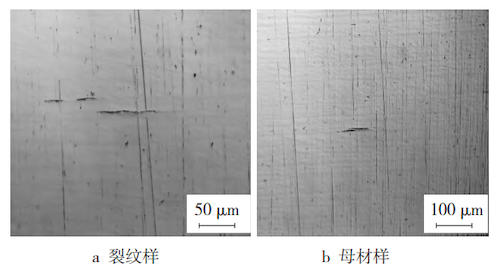
a. Crack Sample b. Base Material Sample
Figure 1. Observation of inclusions in crack and base material samples
Non-metallic inclusions disrupt the continuity of the steel matrix. Their morphology, size, quantity, and distribution can significantly affect the material’s ductility and toughness. During steel strip cutting, bending, or welding, large or brittle inclusions can create stress concentrations, potentially resulting in microcracks or complete cracking. As shown in Figure 1, both samples contained relatively few inclusions, indicating high steel purity. A full-body scan from top to bottom of the crack sample revealed inclusions measuring approximately 75 µm, 23 µm, and 27 µm, including three Class C silicate inclusions. The base material sample contained a single Class C silicate inclusion of approximately 69 µm. Considering the smelting process, the total inclusion content was maintained within Grade 1, indicating that inclusions were not the primary cause of cracking. Polished samples were etched with a 4% nitric acid–alcohol solution for microstructure observation. In accordance with GB/T 13298-2015 Metallic Microstructure Examination Method and GB/T 6394-2017 Method for Determination of Average Grain Size of Metals, microstructure and grain size analyses were conducted.
The cracked square tube sample exhibited a microstructure of pearlite and ferrite with a small amount of bainite, and a grain size of approximately Grade 10. Similarly, the base material sample showed pearlite and ferrite with a small amount of bainite, also with a grain size of Grade 10. Macroscopically, the crack appears transverse; however, upon sectioning, it is revealed as an oblique crack penetrating the full thickness of the steel strip (Figure 2). The grains are uniform and fine, and the microstructure consists mainly of ferrite and pearlite, with only a small amount of bainite. Bainite formation typically occurs when the final rolling temperature is high and the water-cooling rate is elevated. Although a low coiling temperature can enhance matrix strength, it has a slight negative effect on toughness. Although bainite is present near the crack, its content is very low and has minimal impact on toughness, processing, or welding performance. No bainite was observed at either end of the crack. No decarburization or precipitation of Si and Mn oxides was observed, ruling out the presence of pre-existing cracks in the cast billet. The absence of iron oxide scale and metal folds also rules out rolling defects. Furthermore, the metal flow along the crack extends inward following the tear direction, consistent with stress cracking caused by mechanical deformation. As shown in Figure 3, the microstructure and grain size of the base metal are consistent with those of the cracked sample, with no segregation bands or structural anomalies observed. In summary, the chemical composition, microstructure, and mechanical properties of the original steel strip all meet the standard requirements. Based on the crack morphology and the direction of metal flow at the notch, the observed crack is attributed to the shearing and bending–welding processes rather than to material defects.
Common causes of oblique cracks in the joints of low-alloy steel strip pipes include:
Inherent Defects: Defects in the microstructure or at the edges of the base steel strip arising during smelting and rolling.
Shear Defects: Defects resulting from improper operations or process issues during shearing, bending, and welding.
Abnormal Composition During Smelting: If the base steel strip contains elevated levels of elements that promote cracking, such as sulfur, phosphorus, or arsenic, it may lead to segregation or uneven distribution, resulting in abnormal microstructural morphology. This reduces the plasticity and toughness of the steel matrix. Under external loads and welding thermal stress, stress concentrations can develop, ultimately causing cracks.
Inclusions and Harmful Structures: Inadequate refining of molten steel can leave high levels of inclusions or other harmful structures, which may become unevenly distributed during rolling. Large inclusions or highly ductile Class A sulfides disrupt the continuity of the steel matrix, reducing the material’s plasticity and toughness, and causing surface inclusions, edge peeling, and other defects that negatively affect bending and welding quality.
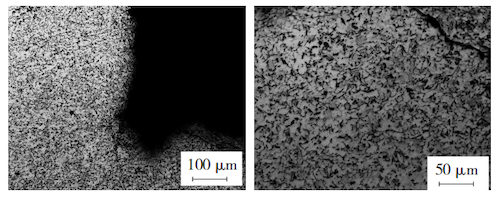
Figure 2. Metallographic structure of crack sample
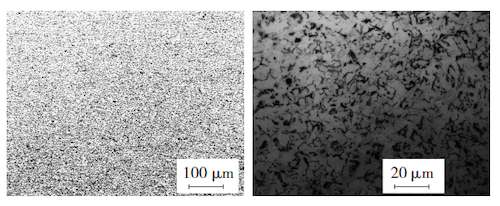
Figure 3. Metallographic structure of base material sample
Slab Rolling Defects: Improper roll adjustment, unsuitable roll geometry, or low edge temperatures during rolling can impede uniform material flow. Localized edge areas may experience stresses exceeding the steel’s strength limit, resulting in longitudinal cracks, edge metal loss, or serrated fractures, all of which can significantly reduce welding efficiency.
Uncoiling and Tensioning Issues: Excessive tensile, bending, or shear forces during steel strip uncoiling—particularly if on-site tension is poorly controlled, equipment performance fluctuates, or sudden power outages occur—can cause base material tearing and strip breakage.
Slitting Defects: Worn, corroded, or damaged slitting shears, or improperly adjusted clearance between the shear blades and the steel strip, can result in incomplete cutting. This can produce dart-shaped or star-shaped fractures, burrs, or shear cracks at approximately 45° to the leveled steel strip. Low-alloy, high-strength, and wear-resistant steels are especially susceptible to such defects.
Disc Shearing Issues: Aging or chipped disc shear blades, improper control of shearing speed, or poor edge quality can produce burrs, sharp corners, or notches. These defects create stress concentrations that, under external loads or welding, may propagate into structural failure.
Root Cause Analysis: Based on the composition, hardness, metallographic structure, and mechanical properties of the longitudinally sheared square tube, the weld crack is attributed to poor shearing quality caused by dull longitudinal shear blades. Key observations supporting this conclusion include:
No decarburization, Si or Mn oxide precipitation, iron oxide scale, or metal folding was observed near the crack, indicating the absence of pre-existing defects in the base material.
Metallographic analysis shows that the metal flow at the crack extends inward along the tear, characteristic of stress-induced cracking. The crack is oblique and penetrates the full 7.75 mm thickness of the steel strip.
Only the middle section of the steel strip, which had been cut at both ends by shears, exhibited periodic discontinuous defects. The sharpness of the shear blades and the quality of the cuts directly influenced post-bending welding efficiency, with dull blades causing oblique edge cracks.
To prevent such defects in production:
Shear Blade Maintenance: Regularly inspect shear blades and replace them promptly if worn or damaged. Ensure the cutting edges remain sharp and precise to reduce stress concentrations and minimize burrs or microcracks.
Optimize Shearing Process: Select shears suitable for the steel strip’s thickness and grade, and properly adjust the blade gap to ensure clean and accurate cuts.
Rubber Pad Adjustment: Correctly set the gap between the steel strip and the rubber pad during shearing. Use pads of appropriate height and size to maintain proper positioning, ensuring high cutting quality and production efficiency.
This study investigated the occurrence of oblique cracks in square tubes manufactured from 7.75 mm × 1055 mm Q355B low-alloy hot-rolled steel strips. During the production processes of slitting, bending, and welding, oblique cracks were observed in the welded joints.
Macroscopic inspection and sampling were performed to analyze the chemical composition, hardness, metallographic structure, grain size, and mechanical properties of the steel strips. The results confirmed that the base material met all relevant standard requirements. Comprehensive analysis indicated that the primary cause of the cracks was shearing defects generated during the slitting process due to dull shear blades.
In practical production, post-weld cracking can be effectively prevented by selecting appropriate slitting shears, performing regular maintenance to keep the blades sharp, and avoiding stress-concentrating defects such as tool corrosion or wear on the steel strip edges. Additionally, optimizing the shearing process—by selecting blades suitable for the strip’s thickness and grade, properly adjusting the blade gap, and positioning shearing pads at appropriate heights according to the strip’s thickness and mechanical properties—can significantly reduce the occurrence of oblique weld cracks.