Abstract: S355NLH seamless steel pipes are widely used in construction and mechanical structures in cold regions. Low-temperature service conditions impose stringent requirements on the following properties:
- Mechanical strength
- Low-temperature impact toughness
- Weldability
To meet these requirements, the chemical composition and manufacturing process were optimized based on the technical specifications for structural steel pipes intended for low-temperature applications. Trace amounts of niobium (Nb), vanadium (V), and titanium (Ti) were added to a plain carbon steel base. Microalloying and grain refinement were employed to improve the balance of strength, toughness, and weldability. The resulting S355NLH seamless steel pipes were manufactured using a normalizing process. They met all specified mechanical property requirements and demonstrated excellent overall performance, particularly in terms of low-temperature impact toughness. These results confirm their suitability for structural applications in cold regions and establish them as a reliable material option for engineering structures exposed to low temperatures.
In recent years, demand for high-strength, high-toughness steel has grown rapidly, particularly for high-grade weldable steel pipes used in construction, offshore engineering, and mechanical structures in cold regions. As a result, the development of cost-effective structural steel pipes that combine high strength with excellent low-temperature toughness has become an important research priority.
S355NLH steel is designed for demanding structural applications and must meet three key performance requirements:
High strength: To provide sufficient load-bearing capacity for structural components.
Excellent low-temperature impact toughness: To maintain structural integrity and resist brittle fracture under cold service conditions.
Good weldability: To ensure reliable welded joints, as structural components such as beams, columns, and support members are commonly joined by welding during construction.
Meeting these requirements is essential to ensuring the safety and reliability of engineering structures operating in low-temperature environments.
S355NLH seamless steel pipes are classified under EN 10210-1:2006, Hot Finished Structural Hollow Sections of Non-Alloy and Fine Grain Structural Steels, and are intended for structural applications in low-temperature environments. They are supplied in the normalized condition. Compared with S355J2H, which is already in production under the same standard, and Q345E specified in GB 8162—2018, Seamless Steel Tubes for Structural Purposes, S355NLH has more stringent requirements for carbon equivalent, mechanical strength, and low-temperature impact toughness.
The chemical composition and mechanical property requirements for S355NLH seamless steel pipes are presented in Tables 1 and 2. The main requirements for chemical composition include:
Nitrogen-binding elements: Provided the specified requirements for nitrogen-binding elements are met, the minimum total aluminum content does not need to be specified.
Carbon equivalent (CEV):
For wall thicknesses (t ≤ 16) mm: CEV ≤ 0.43%.
For wall thicknesses (t > 16) mm: CEV ≤ 0.45%.
The carbon equivalent is calculated from the ladle analysis using the following formula:
CEV = C + Mn/6 + (Cr + Mo + V)/5 + (Ni + Cu)/15.
Table 1. Chemical Composition Requirements (wt.%) for S355NLH Structural Steel Tubes (EN 10210)
Element | Mass fraction (%) |
C | <0.18 |
Si | ≤0.50 |
Mn | 0.90–1.65 |
P | ≤0.030 |
S | ≤0.025 |
Nb | ≤0.050 |
V | ≤0.12 |
Al | ≥0.020 |
Ti | ≤0.03 |
Cr | ≤0.30 |
Ni | ≤0.50 |
Mo | ≤0.10 |
Cu | ≤0.35 |
N | ≤0.020 |
Nominal Wall Thickness (mm) | Yield Strength (MPa) | Tensile Strength (MPa) | Impact Energy at −50°C (J) |
≤16 | 355 | 470–630 | 27 |
>16 | 345 | 470–630 | 27 |
EN 10210-1:2006 does not prescribe specific chemical compositions for individual steel grades. Instead, it specifies general composition limits while placing greater emphasis on mechanical property requirements. To ensure that S355NLH meets the required performance criteria, small amounts of niobium (Nb), vanadium (V), and titanium (Ti) are added to a low-carbon steel base. The combined effects of solid-solution strengthening, precipitation strengthening, and grain refinement improve the steel's strength and impact toughness across a wide temperature range while maintaining good weldability. The target chemical composition is presented in Table 3.
Table 3. Chemical Composition Design Requirements (wt.%) for S355NLH Structural Pipes
C | Si | Mn | P | S | Al | V+Nb+Ti |
0.10–0.17 | 0.20–0.30 | 1.00–1.50 | ≤0.018 | ≤0.008 | ≤0.050 | ≤0.150 |
The production process for the industrial trial run consisted of the following stages:
Hot metal pretreatment → Top-and-bottom combined-blown converter steelmaking → Ladle furnace (LF) refining → Round billet continuous casting → Billet reheating → Piercing → PQF rolling and sizing/reducing → Cutting on the cooling bed → Heat treatment → Inspection → Stencil marking → Warehousing.
Converter steelmaking was carried out using blast furnace hot metal and scrap steel as the primary raw materials. Before being charged into the converter, the hot metal was desulfurized using the KR process. A single-slag process involving high-carbon tapping and reblowing was adopted, with the phosphorus (P) content of the molten steel controlled at ≤0.010% at the end of blowing. Silicomanganese and ferromanganese alloys were used for deoxidation and alloying, while an aluminum-iron alloy served as the final deoxidizer. The molten steel temperature at the end of blowing was maintained between 1,620°C and 1,660°C.During ladle furnace (LF) refining, the main operations included slag-based desulfurization, chemical composition adjustment, and temperature control based on the condition of the molten steel after converter tapping. Deoxidation was further intensified, and the additions of the microalloying elements niobium (Nb), vanadium (V), and titanium (Ti) were carefully controlled during the later stages of refining.
The strength and ductility of steel at elevated temperatures directly affect rolling stability and the internal and external surface quality of the finished pipes. To optimize the rolling process for S355NLH low-temperature structural pipes, hot ductility tests were conducted over a temperature range of 800°C to 1,300°C using an MMS-200 thermomechanical simulator. The specimens were heated in a vacuum at a rate of 10°C/s, held at 1,300°C for 3 min, and then cooled at 3°C/s. Tensile tests were performed at 50°C intervals from 800°C to 1,300°C. Before testing, the specimens were held at each target temperature for 2 min. After fracture, they were air-cooled to room temperature. The hot ductility of the steel was evaluated based on the reduction of area. The test results are presented in Fig. 1.
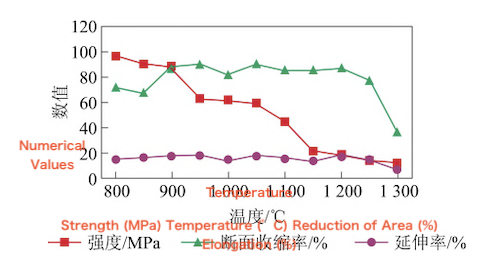
Figure 1. High-Temperature Tensile Performance Curves for S355NLH Structural Pipes
A reduction of area of 60% is generally used as the threshold for evaluating steel hot ductility. The test results show that the reduction of area reaches a maximum of 90.39% at 950°C. As the temperature increases further, it decreases gradually to 77.91% at 1,250°C, followed by a sharp drop to 36% at 1,300°C. Meanwhile, the tensile strength decreases with increasing temperature, with a more pronounced decline above 900°C, reaching 63.02 MPa at 950°C. The results indicate that S355NLH steel exhibits relatively low strength and good hot ductility over the temperature range of 900–1,250°C. Therefore, the rolling deformation temperature should be controlled within this range.
Low-alloy steel pipes in the hot-rolled condition generally cannot meet the impact toughness requirements at −50°C. Normalizing or quenching and tempering (Q&T) is therefore required to improve their strength and toughness. In construction and mechanical engineering applications, structural components are commonly joined by welding. However, conventional low-carbon Q&T steels are susceptible to cold cracking in the heat-affected zone (HAZ), particularly in the coarse-grained region, where toughness may also deteriorate. In addition, HAZ regions that are not fully austenitized, or whose peak temperatures exceed the steel's original tempering temperature but remain below the lower critical transformation temperature (Ac₁), may undergo softening or embrittlement. Therefore, normalizing is the preferred heat treatment for structural steel pipes intended for low-temperature service.
(1) The Ac₃temperature of this steel grade was estimated from the theoretical formula Ac₃= 910 − 320[C] − 14[Ni] − 12[Cu] − 10[Mn] + 5[Cr] + 14[Mo] + 18[Si], giving a calculated value of 845°C.
(2) Determination of the CCT Curve
A thermal dilatometer was used to determine the phase transformation temperatures of the steel. The specimens were austenitized at 910°C for 10 min and then cooled at different rates of 30, 20, 10, 5, 2, 1, and 0.5°C/s. The measured Ac₁, Ac₃, Ar₁, and Ar₃ temperatures were 715°C, 839°C, 605°C, and 752°C, respectively. The resulting continuous cooling transformation (CCT) diagram for the undercooled austenite is shown in Fig. 2.
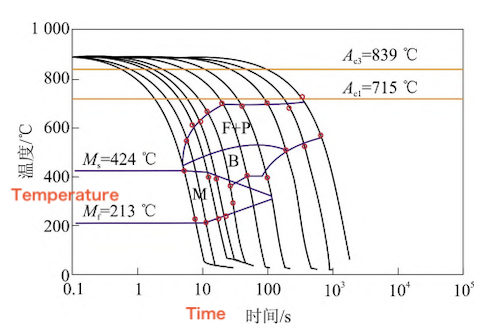
Fig. 2 CCT Diagram of S355NLH Structural Steel
(3) Formulation of the Heat Treatment Process
In accordance with the applicable standards, structural steel pipes are generally heat-treated by normalizing. This treatment refines the grain structure, improves the strength, hardness, and toughness of the steel, and reduces its susceptibility to cracking. For hypoeutectoid steels, the normalizing temperature is typically set at Ac₃ + 30–50°C. In industrial production, however, higher temperatures are often used to accelerate austenitization and shorten the production cycle. Considering the actual production conditions, a normalizing temperature of 900°C was selected. The heat treatment schedule consisted of holding the pipes at 900°C for 50 min, followed by air cooling.
(1) Metallographic Examination
The microstructure and nonmetallic inclusions in the heat-treated pipe body were examined. The inclusion ratings indicated good cleanliness: thin Type A and Type D inclusions were both rated 0.5, thin Type B inclusions were rated 1.0, and all other inclusion types were rated 0. Metallographic specimens were taken from both the as-rolled pipe and the normalized finished pipe. The examination results are shown in Fig. 3. After normalizing, the grain structure became noticeably finer and more uniform. The microstructure consisted of ferrite and pearlite, with a grain size of Grade 8.
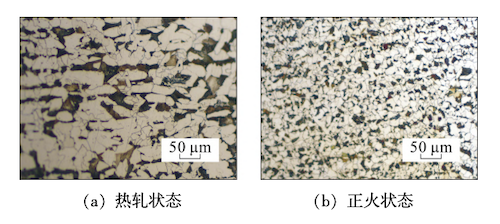
(a) As-rolled condition (b) Normalized condition
Fig. 3 Metallographic Microstructures of S355NLH Steel Pipes for Low-Temperature Service
(2) Mechanical Properties
The actual pipe dimensions after rolling were Φ406 mm × 15 mm. After normalizing, the mechanical properties of the pipes were evaluated using longitudinal specimens. The test results are presented in Table 4. The results show that the normalized pipes fully met the specified mechanical property requirements and exhibited good low-temperature impact toughness.
Table 4. Mechanical Properties of S355NLH Steel Pipes for Low-Temperature Service
Property | Maximum | Minimum | Average |
Yield Strength (MPa) | 458 | 374 | 407 |
Tensile Strength (MPa) | 599 | 527 | 555 |
Elongation (%) | 36.5 | 30 | 34 |
Impact Energy at −50°C (J) | 150 | 91 | 131 |
To further evaluate the low-temperature impact performance of the developed steel grade, impact tests were conducted at 0, −20, −40, −50, −60, −70, and −80°C. As shown in Fig. 4, the impact energy begins to decrease gradually at temperatures below −50°C but remains above 70 J even at −80°C. These results demonstrate that the steel, after normalizing at 900°C, meets all specified standard requirements and exhibits excellent low-temperature impact toughness. It is therefore suitable for high-strength structural applications in cold regions, including construction, offshore engineering, and mechanical structures.
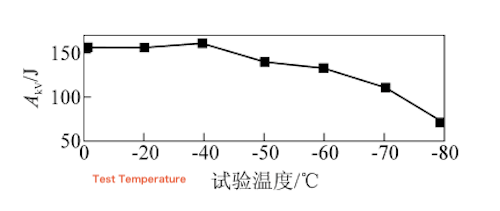
Fig. 4 Impact Energy of S355NLH Steel Pipes at Different Temperatures
(1) Based on the microalloying principles for low-alloy structural steels, small additions of niobium (Nb), vanadium (V), and titanium (Ti) promote solid-solution strengthening, precipitation strengthening, and grain refinement. These mechanisms enable the steel to achieve high strength, excellent low-temperature impact toughness, and good weldability.
(2) Laboratory tests and industrial-scale production trials confirmed that the developed S355NLH structural steel pipes for low-temperature service meet all specified standard requirements. After normalizing, the pipes exhibit excellent mechanical properties and low-temperature toughness, with an average longitudinal impact energy of at least 90 J at −50°C.