Abstract: Gr. 6 seamless steel pipes are widely used in low-temperature applications, where their toughness is critical to service life and operational safety. This study investigates abnormal fluctuations in the impact energy at −45 °C observed in a batch of Gr. 6 seamless steel pipes. Samples exhibiting high and low impact energy values were selected for comparative analysis.
The analysis focused on three aspects:
- Inclusion characteristics
- Room-temperature microstructural features
- Fracture surface morphology
The results indicate that differences in banded microstructure and the nonuniform distribution of low- and high-angle grain boundaries are the primary factors contributing to the abnormal fluctuations in low-temperature impact toughness.
To address these issues, the following heat treatment measures are recommended:
- Increase the cooling rate to suppress the formation of banded microstructures
- Strictly control the heating temperature and holding time to improve microstructural uniformity
These measures can help improve low-temperature impact toughness and ensure product quality.
Low-temperature seamless steel pipes are widely used in the petroleum, chemical, natural gas, and coal chemical industries. Their applications include the production of:
- Ethylene and propylene
- Urea and synthetic ammonia
- Pharmaceuticals
These pipes are also commonly used in processes such as scrubbing, purification, desulfurization, and degreasing. In addition, they are essential for manufacturing cryogenic equipment and transporting gases at extremely low temperatures. Because these pipes often operate under low-temperature conditions for extended periods, their low-temperature toughness is a critical material property that directly affects their service life and operational safety.
Causes of Abnormal Fluctuations in the Low-Temperature Impact Toughness of Gr. 6 Seamless Steel Pipes
ASTM A333/A333M-2024, Standard Specification for Seamless and Welded Steel Pipe for Low-Temperature Service and Other Applications with Required Notch Toughness, is the principal international standard governing low-temperature steel pipes and covers nine grades. Among these, Grade 6 (Gr. 6) is a nickel-free, aluminum-killed steel designed for low-temperature service. Its microstructure consists primarily of body-centered cubic (BCC) ferrite, which provides good tensile properties, low-temperature toughness, and weldability. Notably, Gr. 6 steel has been specified for use in the primary cooling systems of nuclear power plants in India.
During impact testing at −45 °C in accordance with ASTM A333/A333M-2024, a steel pipe manufacturer identified an abnormal “two-high, one-low” pattern in the impact energy results for a batch of Gr. 6 seamless steel pipes. Specifically, in each set of three test specimens, two exhibited high impact energy values, whereas the third showed a markedly lower value. The two higher values were several times greater than the lower value. Numerous studies have investigated variations in the low-temperature impact toughness of steel. Zhang Zhen reported that the failure of 1290M steel to meet low-temperature toughness requirements was primarily attributable to increased sulfur (S) content, which promoted the formation of manganese sulfide (MnS) inclusions and consequently reduced the toughness of the steel strip. Li Xiangqian identified carbon (C) and manganese (Mn) centerline segregation, together with the formation of Widmanstätten ferrite, as the primary causes of S355-series steels failing to meet the specified toughness requirements. Yang Jianwei et al. investigated the failure of Q345D low-alloy high-strength steel to meet low-temperature impact energy requirements, identifying three main contributing factors: inappropriate chemical composition design, excessive pearlite content in the microstructure, and coarse grain size.
Zhang Zechen reported that the pronounced fluctuations in the −50 °C impact energy of S355NL steel forgings (flanges) were attributable to microstructural nonuniformity, including variations in grain size, banded structures, and localized pearlite clustering. These microstructural features collectively raised the ductile-to-brittle transition temperature. Overall, the low-temperature toughness of steel is influenced by several factors, including chemical composition, inclusion characteristics, microstructure, and manufacturing processes. To investigate the causes of the abnormal “two-high, one-low” fluctuation in the impact energy at −45 °C observed in a batch of Gr. 6 seamless steel pipes, this study compares two groups of specimens with high and low impact energy values, respectively. The specimens were examined in terms of inclusion composition and morphology, microstructural characteristics, and fracture surface features using optical microscopy (OM), scanning electron microscopy (SEM), electron backscatter diffraction (EBSD), energy-dispersive X-ray spectroscopy (EDS), and X-ray diffraction (XRD). Based on the comparative analysis, the study aims to identify the underlying causes of the abnormal impact energy fluctuations and propose measures to improve product quality.
The material used in this study was Gr. 6 low-temperature seamless steel pipe normalized at 920 °C for 30 min. The main chemical composition is listed in Table 1. Impact specimens were taken from the pipes in the longitudinal direction. At each sampling location, three adjacent specimens measuring 10 mm × 10 mm × 55 mm, each with a V-notch, were prepared as a test set. The impact energy values measured at −45 °C were 360 J, 367 J, and 32 J, exhibiting a typical “two-high, one-low” pattern. All three values exceeded the minimum requirement of 18 J specified in ASTM A333/A333M-2024. The specimens with impact energy values of 360 J and 32 J were designated G-360 and L-32, respectively. Both were examined for inclusion characteristics, microstructural features, and fracture surface morphology using optical microscopy (OM), scanning electron microscopy (SEM), energy-dispersive X-ray spectroscopy (EDS), electron backscatter diffraction (EBSD), and X-ray diffraction (XRD) to determine the causes of the abnormal fluctuations in low-temperature impact energy.
Figure 1 shows the SEM morphologies and corresponding EDS elemental maps of inclusions in the G-360 and L-32 samples. Two typical types of inclusions were identified in both samples, with no significant differences between them. The inclusion in Figure 1(a) is approximately 4 μm in size and has an ellipsoidal morphology, with distinct contrast regions under SEM. The darker upper region is enriched in Mg, Al, and O, whereas the gray lower region contains Mn, Ca, and S. This indicates that the inclusion consists of an Mg-Al-O core with an attached (Mn, Ca)S phase. The second type of inclusion, shown in Figure 1(b), is approximately 2 μm in size and is primarily enriched in Ca, Mn, and S, indicating that it is also a (Mn, Ca)S inclusion.
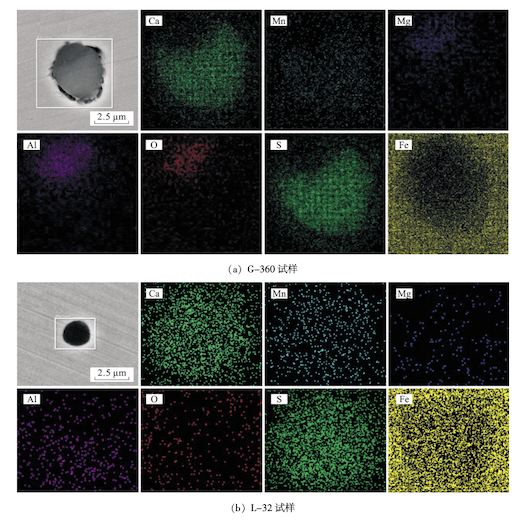
Figure 1. SEM morphologies and corresponding EDS elemental maps of inclusions in the G-360 and L-32 samples
(a) G-360 sample (b) L-32 sample
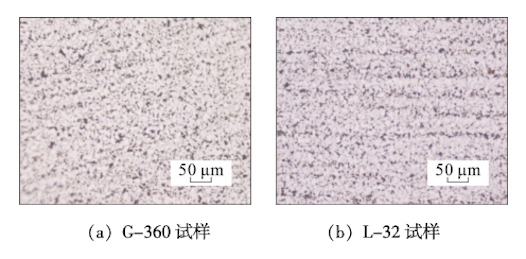
Figure 2. Room-temperature microstructures of the G-360 and L-32 samples
(a) G-360 sample (b) L-32 sample
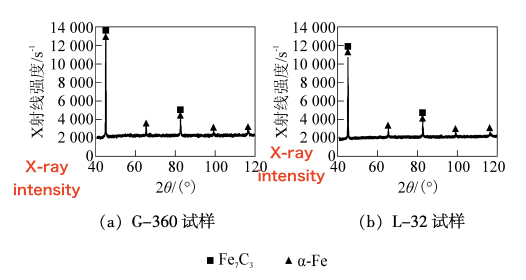
Figure 3. XRD phase analysis results for the G-360 and L-32 samples
The room-temperature microstructures and XRD phase analysis results of the G-360 and L-32 samples are presented in Figures 2 and 3, respectively. As shown in Figure 3, both samples consist of ferrite and cementite phases. In Figure 2, the light-colored regions correspond to polygonal ferrite, while the dark-colored regions represent pearlite, which is primarily distributed along the ferrite grain boundaries. Both samples exhibit a microstructure consisting of polygonal ferrite and pearlite, with a more pronounced banded structure in the L-32 sample. Within these bands, pearlite forms continuous strips. Previous studies have shown that differences in toughness and ductility between ferrite and pearlite cause the two phases to deform nonuniformly under impact loading. This deformation incompatibility promotes microcrack initiation at phase interfaces, followed by rapid crack propagation and eventual fracture.
To further characterize the microstructural differences between the two samples, EBSD analysis was performed to determine their effective grain sizes and crystallographic orientation distributions, as shown in Figure 4. Figures 4(a) and 4(b) show the grain orientation maps of the G-360 and L-32 samples, respectively, with both maps representing the ferrite phase. According to the Kurdjumov–Sachs (K-S) orientation relationship, ferrite variants formed from the same prior austenite grain in low-carbon steel exhibit different crystallographic orientations, which are represented by distinct colors in the maps. Figures 4(c) and 4(d) show the corresponding grain boundary distributions, with low-angle grain boundaries (2°–15°) indicated by solid black lines and high-angle grain boundaries (>15°) by solid red lines.
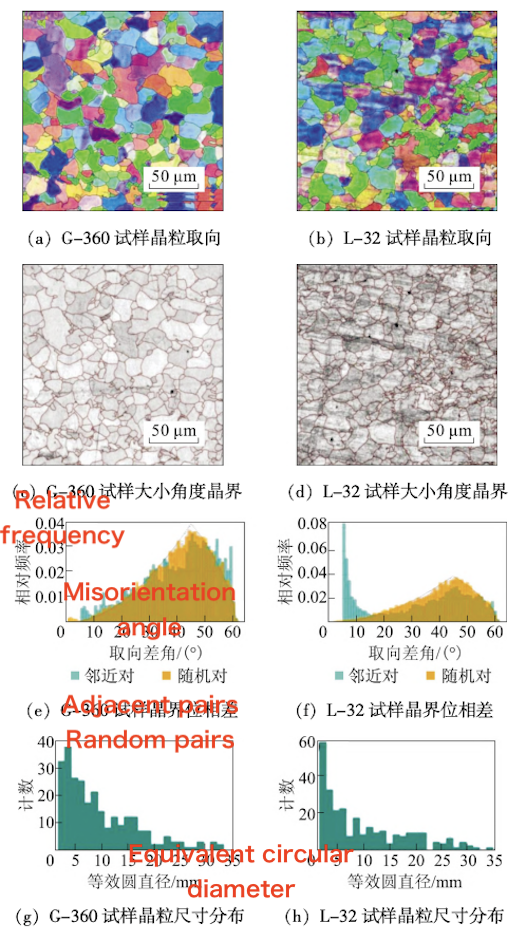
Figure 4. Grain orientation maps, grain boundary distributions, misorientation angle distributions, and effective grain size distributions of the G-360 and L-32 specimens
(a) Grain orientation map of the G-360 specimen (b) Grain orientation map of the L-32 specimen
(c) Grain boundary distribution in the G-360 specimen (d) Grain boundary distribution in the L-32 specimen
(e) Grain boundary misorientation angle distribution in the G-360 specimen (f) Grain boundary misorientation angle distribution in the L-32 specimen
(g) Effective grain size distribution in the G-360 specimen (h) Effective grain size distribution in the L-32 specimen
Figures 4(e) and 4(f) show the distributions of misorientation angles between adjacent grains in the G-360 and L-32 samples, respectively. Most adjacent grains in the G-360 sample are separated by high-angle grain boundaries (>15°), whereas low-angle grain boundaries (2°–15°) predominate in the L-32 sample. However, some high-angle grain boundaries with misorientation angles ranging from 50° to 62° are also present in the L-32 sample. As summarized in Table 2, the high-angle grain boundary (HAGB) fraction is 89.8% in the G-360 specimen, significantly higher than the 32.9% measured in the L-32 specimen. Grain boundary misorientation plays an important role in the low-temperature impact toughness of steel. Larger misorientation angles increase the resistance to crack propagation across grain boundaries, thereby impeding crack growth and improving impact toughness. Consequently, the higher proportion of high-angle grain boundaries in the G-360 specimen helps explain its superior low-temperature impact toughness compared with the L-32 specimen. Figures 4(g) and 4(h) show the effective grain size distributions of the G-360 and L-32 specimens, respectively. The mean effective grain sizes are 9.6 μm and 9.3 μm, respectively (Table 2). The distributions across different grain size ranges are similar, with no obvious differences between the two specimens.
In Charpy V-notch impact tests conducted at −45 °C, the G-360 and L-32 specimens exhibited impact energy values of 360 J and 32 J, respectively. The corresponding SEM micrographs of their impact fracture surfaces are shown in Figure 5. The fracture morphologies are consistent with the impact toughness of the two specimens. The G-360 specimen exhibits dimples of varying sizes. These dimples are generally parabolic in shape, with their convex sides facing the crack initiation site. This morphology is characteristic of ductile tearing and indicates good toughness. In contrast, the L-32 specimen exhibits a river-like fracture pattern characteristic of brittle fracture, with only a few dimples observed near the V-notch and at the end of the fracture surface. During impact loading, cracks initiate at the root of the V-notch and propagate rapidly along specific crystallographic planes through cleavage, crossing adjacent grains until fracture occurs. When a crack encounters a low-angle grain boundary, its propagation direction changes slightly to accommodate the crystallographic orientation of the neighboring grain, after which it continues to propagate into the adjacent grain. This process produces a continuous river pattern, consistent with the high proportion of low-angle grain boundaries observed in the L-32 specimen (Figures 4(d) and 4(f)).
Table 2. Average effective grain size and fractions of low- and high-angle grain boundaries in the G-360 and L-32 specimens
Specimen ID | Average effective grain size (μm) | Low-angle grain boundaries (%) | High-angle grain boundaries (%) |
G-360 | 9.6 | 10.2 | 89.8 |
L-32 | 9.3 | 67.1 | 32.9 |
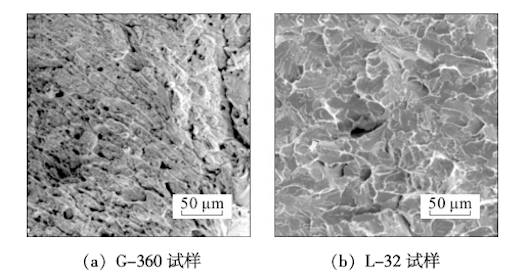
(a) G-360 specimen (b) L-32 specimen
Figure 5. SEM micrographs of the impact fracture surfaces of the G-360 and L-32 specimens tested at −45 °C
The analysis indicates that the G-360 and L-32 specimens exhibit no obvious differences in inclusion characteristics. However, the L-32 specimen has a more pronounced banded microstructure at room temperature than the G-360 specimen. In addition, the proportion of high-angle grain boundaries in the G-360 specimen is 89.8%, significantly higher than the 32.9% measured in the L-32 specimen. The fracture surface of the L-32 specimen exhibits a river-like pattern characteristic of brittle fracture, whereas that of the G-360 specimen is characterized by dimples, indicating ductile fracture. These findings suggest that the abnormal fluctuations in the low-temperature impact toughness of Gr. 6 seamless steel pipes are primarily associated with differences in banded microstructure and grain boundary misorientation distributions.
Since the G-360 and L-32 specimens were taken from adjacent longitudinal locations within the same steel pipe, the observed microstructural heterogeneity may be related to nonuniform heating during heat treatment. Regions exposed to higher temperatures may have developed coarser austenite grains, whereas regions exposed to lower temperatures may have undergone incomplete austenitization or retained finer austenite grains. These differences may subsequently have resulted in variations in the crystallographic orientation distributions of ferrite and pearlite after cooling.
(1) Both the G-360 and L-32 specimens from the Gr. 6 seamless steel pipe contain two types of inclusions: composite inclusions consisting of an Mg-Al-O core with an attached (Mn, Ca)S phase, and standalone (Mn, Ca)S inclusions. Both specimens consist primarily of ferrite and cementite. Compared with the G-360 specimen, the L-32 specimen exhibits a more pronounced banded microstructure and a lower proportion of high-angle grain boundaries (32.9% versus 89.8%). The impact energies at −45 °C are 360 J for the G-360 specimen and 32 J for the L-32 specimen. These results indicate that differences in banded microstructure and grain boundary misorientation distributions are the primary factors contributing to the abnormal fluctuations in the low-temperature impact toughness of Gr. 6 seamless steel pipes.
(2) To reduce microstructural inhomogeneity in the steel pipe, the heating temperature and holding time should be strictly controlled to ensure uniform austenitization. In addition, increasing the cooling rate can help suppress the formation of banded microstructures, thereby improving low-temperature impact toughness.